

Learning Thai language with a language-obsessive coach!
Category: Uncategorized

sà-wàd-dēe kà
This is the first word that we will use to greet each other. It might also be the first Thai word that you know but in reality it is not Thai. Actually, this is a Sanskrit word, created by Phraya Upakitsinlapasan (1879 – 1941) for greeting between students and professors in the faculty of Liberal Arts, Chulalongkorn University when he worked as a professor there. It became the official greeting word in 1943 by Field Marshal Plaek Phibunsongkhram (1897 – 1964), the Prime Minister of Thailand at that time.
สวัสดี /sà-wàd-dēe/ is a compound word from a prefix สุ /sù/ (meaning good, beautiful, easy) and a word อสฺติ /àd-sà-dtì/ (meaning there is, there are, have). When these two words merged together following the grammar rules, สุ /sù/ became สว /sà-wà/. Plusing อสฺติ /àd-sà-dtì/, สวสฺติ /sà-wàd-dì/ means ‘Wish (you) goodness and virtue!’ It reminds me of the phrase “May the force be with you!” Does it ring a bell? LOL
This word was originally a short vowel sound for all syllables but Phraya Upakitsinlapasan changed the last syllable into a long sound to make it sound better.
After that, there were some more greeting words created such as อรุณสวัสดิ์ /à-run-sà-wàd/ for ‘good morning’, ทิวาสวัสดิ์ /tí-waa-sà-wàd/ for ‘good afternoon’, สายัณห์สวัสดิ์ /săa-yan-sà-wàd/ for ‘good evening’ and ราตรีสวัสดิ์ /raa-dtee-sà-wàd/ for ‘good night’. However, these words are not as popular as สวัสดี /sà-wàd-dēe/ which we can use any time during the day. Only อรุณสวัสดิ์ /à-run-sà-wàd/ for ‘good morning’ and ราตรีสวัสดิ์ /raa-dtee-sà-wàd/ for ‘good night’ are still used until now.
sà-wàd-dēe kà!
May the virtue be with you!

There are 2 different systems to tell time in Thai. The easiest one is the official way. We will use 0 to 24 following by a word นาฬิกา /naa-lí-gaa/. นาฬิกา /naa-lí-gaa/ means clock, watch or o’clock. It’s very simple but nobody uses it in spoken language. I mean, you can talk with people by using this system but please don’t expect anyone else who are Thai to refer to this system when talking about time.
So, how do Thai people tell time in general?
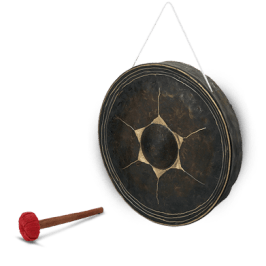
In the ancient time when people didn’t have watches, clocks everywhere like now. A City Hall or a temple was responsible for telling time. During the daytime, they would hit a kong. People thought that its sounds was like ‘moeng’ (โหม่ง) so, they said ‘moeng’
At night, they changed the instruments. From 7 P.M. until midnight, they hit a drum instead. People heard its sound like ‘dtum’ (ตุ้ม) so they said ‘tum’. After midnight, it was not clear what exactly was the instrument for telling time. In the peaceful time, it might be possible that no one was awake the whole night to tell time. Anyway, they assumed that some kind of metal will be used to hit from 1 A.M. until 5 A.M. That’s why we use the word ตี /dtee/, meaning hit, slap, etc.
|
Official Time (24-hour based system) |
6-hour based system (Originally) |
6-hour based system (Nowadays) |
| 1 naa-lí-gaa | dtee 1 | dtee 1 |
| 2 naa-lí-gaa | dtee 2 | dtee 2 |
| 3 naa-lí-gaa | dtee 3, 3 yaam | dtee 3 |
| 4 naa-lí-gaa | dtee 4 | dtee 4 |
| 5 naa-lí-gaa | dtee 5 | dtee 5 |
| 6 naa-lí-gaa | dtee 6, yâm-rûng | 6 moeng-cháo |
| 7 naa-lí-gaa | 1 moeng-cháo | 7 moeng-cháo |
| 8 naa-lí-gaa | 2 moeng-cháo | 8 moeng-cháo |
| 9 naa-lí-gaa | 3 moeng-cháo | 9 moeng-cháo |
| 10 naa-lí-gaa | 4 moeng-cháo | 10 moeng |
| 11 naa-lí-gaa | 5 moeng-cháo, pen | 11 moeng |
| 12 naa-lí-gaa | tîang, tîang-wan, yâm-tîang | tîang, tîang-wan |
| 13 naa-lí-gaa | bàay 1 moeng | bàay moeng |
| 14 naa-lí-gaa | bàay 2 moeng | bàay 2, 2 moeng |
| 15 naa-lí-gaa | bàay 3 moeng | bàay 3, 3 moeng |
| 16 naa-lí-gaa | bàay 4 moeng | bàay 4 (moeng), 4 moeng-yen |
| 17 naa-lí-gaa | bàay 5 moeng | 5 moeng-yen |
| 18 naa-lí-gaa | 6 moeng-yen, yâm-kâm | 6 moeng-yen |
| 19 naa-lí-gaa | 1 dtûm | 1 dtûm |
| 20 naa-lí-gaa | 2 dtûm | 2 dtûm |
| 21 naa-lí-gaa | 3 dtûm, yaam 1 | 3 dtûm |
| 22 naa-lí-gaa | 4 dtûm | 4 dtûm |
| 23 naa-lí-gaa | 5 dtûm | 5 dtûm |
| 24 naa-lí-gaa, 0 naa-lí-gaa | tîang-keun, 6 dtûm, 2 yaam | tîang-keun |

 Thai Lessons: บทเรียนภาษาไทย